

Get free quotes from non-destructive testing services near you
Takes about a minute. Free, no obligation; providers reply to you directly.
I watched a $40,000 radiography inspection get rescheduled twice because a facility manager didn’t stock penetrant, didn’t verify technician credentials, and had no idea the work area didn’t meet lighting standards. The NDT firm showed up, ran through a 15-minute site walk, and left. Two weeks later: invoice, no inspection done, and a very frustrated plant engineer asking “what went wrong?”
What went wrong was preparation. Or rather, the complete absence of it.
NDT inspections aren’t like hiring a plumber who shows up with their own toolkit and adapts to whatever they find. These are highly regulated, procedure-driven sessions where the facility manager’s job is to make the inspection possible—not just tolerable. Get it right, and the technician walks in, executes flawlessly, and you get defensible results. Get it wrong, and you’re rescheduling, paying travel fees again, and watching your maintenance timeline slip.
Here’s what I found when I actually talked to NDT firms, reviewed ASNT standards, and catalogued what separates smooth inspections from disasters.
The Short Version:Verify technician certifications, confirm equipment calibration and consumables are on-site, ensure >1000 lux lighting for visual testing, have approved procedures available, and prep the work area 48 hours before the inspection. Use the checklist below and walk through your facility one week out. Nobody will forgive you for missing this.
Key Takeaways
- Technician credentials matter legally. Inspectors must hold ISO 9712 or ASNT Level II/III certification—check it yourself, don’t assume.
- Equipment readiness breaks inspections more often than you’d think. Pre-check function, confirm calibration certificates are traceable and current, stock consumables (penetrant, couplant, probes).
- Environmental conditions have hard limits. Visual Testing requires >1000 lux lighting; temperature and humidity matter for specific methods.
- Documentation kills more inspections than technical errors. Obsolete procedures on-site, missing specs, or routing docs in the wrong place turn a 2-hour inspection into a rescheduled headache.
The Reality: What Makes NDT Inspections Fail (Before They Start)
Here’s what the industry doesn’t advertise: 80% of inspection delays trace back to facility prep, not technician competence.
NDT firms operate under ASNT SNT-TC-1A standards and ISO 9712 requirements. These aren’t suggestions—they’re enforceable baselines that govern how technicians are certified, how equipment is maintained, and how results are documented. If your facility isn’t aligned with these standards before the inspection begins, the technician legally can’t proceed.
Reality Check:One facility manager thought a technician could “just use their own gear” when on-site equipment was uncalibrated. It took a 30-minute conversation to explain that the inspection results wouldn’t be traceable, defensible, or acceptable to the client. The inspection got cancelled.
The specifics:
- Personnel: Technicians must hold current certifications and pass medical fitness checks for certain methods (radiography, for example). Your job is to verify credentials before they step foot on-site.
- Equipment: Every instrument needs a valid, traceable calibration certificate. Not “probably calibrated”—actively traceable to an accredited lab, with annual or semi-annual renewal.
- Environment: Lighting for visual testing hits a hard floor at 1,000 lux. Dust, vibration, and temperature swings outside acceptable ranges can invalidate results.
- Procedures: You need the actual approved NDT procedure on-site, matching the contract specification. Not a generic template—the specific document the technician will follow.
- Safety: Personal protective equipment, radiation barriers for radiography, fire extinguishers, emergency exits. Non-negotiable.
Most facilities skip 2-3 of these. Then the technician arrives, does a 10-minute walk-through, and reschedules.
The Facility Manager’s Pre-Inspection Checklist (7 Days Before)
Use this as your action plan. Work backward from your scheduled inspection date.
1. Personnel & Credentials (Verify Immediately)
| Item | Requirement | How to Verify |
|---|---|---|
| Technician Certification | ASNT Level II/III or ISO 9712 current | Request cert copy; check expiration against inspection date |
| Medical Fitness | Required for RT (radiography), UT in some cases | Ask NDT firm for documentation; ask about visual/hearing requirements |
| Photo ID / Badge | Visible identification on-site | Confirm with firm; check for high-risk facility protocols |
| Experience with Your Asset Type | Previous inspections on similar equipment | Ask firm about relevant case history |
Pro Tip: Don’t assume the firm vetted this. Call 48 hours before and ask directly: “Who’s inspecting, what’s their current cert level, and can you email me proof?” NDT firms expect this.
2. Equipment & Calibration (Check Inventory)
This is where most facilities stumble.
Confirm the following are available, functional, and calibrated:
- Probe/transducer sets (if ultrasonic testing)
- Couplant (gel for UT contact; check expiration)
- Penetrant kit (liquid penetrant testing supplies)
- Magnetic yoke or powder (magnetic particle testing)
- Calibration certificates for all equipment—must be current, traceable to an accredited lab
- Reference standards (blocks, coupons) for comparison during testing
- Lighting meters or hand gauges to verify >1000 lux in work area
Reality Check: A facility stocked penetrant from 2019. It had gummed up and separated. The inspection couldn’t proceed until new supplies arrived—3-day delay.
Function Check Protocol (48 Hours Before):
- Power on each instrument; listen for abnormal sounds
- Run a quick calibration check using reference materials (per manufacturer specs)
- Visually inspect probes/cables for cracks or corrosion
- Confirm couplant isn’t dried out; check expiration dates
3. Environment & Access (Walk the Work Area)
Inspection success lives in the details. Walk the actual site one week out.
Lighting (Critical for Visual Testing):
- Measure existing light levels with a meter or request the NDT firm bring one
- If <1000 lux, arrange temporary lighting (LED work lights, clip lamps)
- Test that lighting 48 hours before to confirm it holds steady
Work Area Cleanliness:
- Clear clutter, debris, and loose items from the inspection perimeter
- Remove trip hazards; inspect for sharp edges
- Confirm fire exits are unobstructed; test fire alarms
Surface & Part Preparation:
- If the procedure requires cleaning, do it in advance (per spec—some methods require specific degreasing agents)
- Remove rust, paint, or coatings only if the procedure calls for it; wrong prep invalidates results
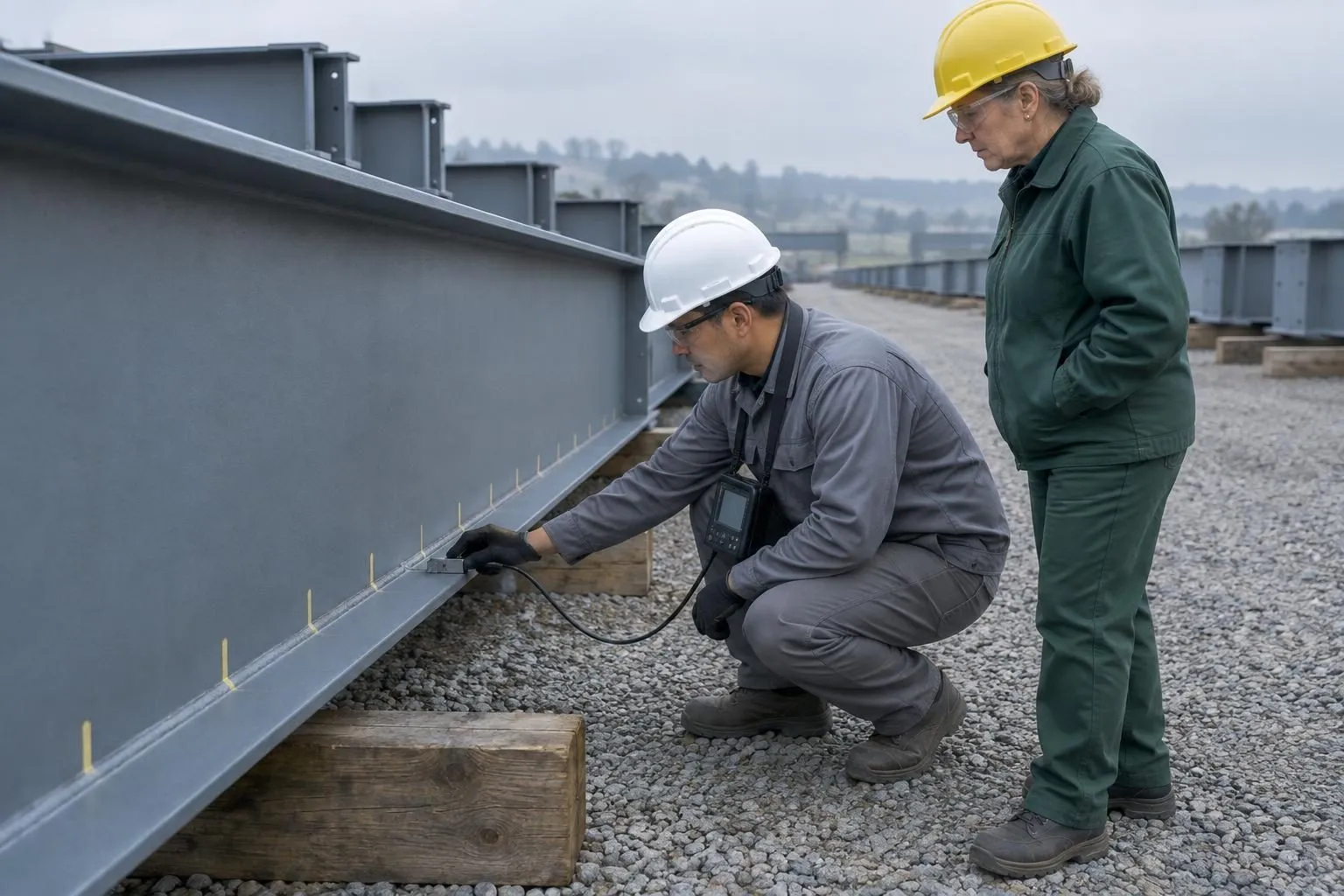
- Have part accessible without metal-to-metal contact damage (use wooden blocks, soft slings, not chains directly on surfaces)
Temperature & Humidity:
- Confirm HVAC is functional; extreme humidity can invalidate liquid penetrant or coating inspection
- Check forecast for the inspection day; if temperatures will drop below procedure limits, alert the NDT firm in advance
Pro Tip: If you’re inspecting in an outdoor or high-exposure area, have a weather contingency. Many NDT methods can’t proceed in rain or wind.
4. Documentation & Procedures (Assemble Your Packet)
This is your legal backbone.
Gather and organize:
- Original contract or statement of work (what’s being inspected, acceptance criteria)
- Approved NDT procedure (the specific procedure number the technician will follow—not a generic template)
- Relevant codes/standards (ASTM, API, ISO—whatever applies to your asset)
- Equipment specifications (asset drawings, manuals if relevant)
- Previous inspection reports (if any; gives technician context)
- Surface condition notes (any known degradation, previous repairs, areas of concern)
ASNT SNT-TC-1A Best Practice: Keep current revisions in a digital folder accessible during the inspection. If the technician spots something and asks “what version of API 1104 are we following?”—you have the answer in 10 seconds, not 10 minutes.
Reality Check: Obsolete procedures on-site are worse than no procedure. A facility used a 2015 procedure when the 2021 revision had stricter acceptance criteria. The inspection results were technically valid but didn’t meet current codes. Full re-inspection required.
5. Safety Protocols (Pre-Establish Rules)
- PPE: Ensure gloves, safety glasses, steel-toed boots are available and enforced
- Radiation protocols (if radiography): Verify barriers, warning signs, dosimeter access
- Emergency procedures: Know your facility’s evacuation plan; communicate it to the NDT firm
- Hot work permits: If the inspection involves any grinding/cutting prep, verify permits are in place
- Confined space entry: If accessing tanks or enclosed areas, have atmosphere testing and rescue equipment ready
6. Scheduling & Communication (Lock in Timeline)
Contact the NDT firm one week before with:
- Confirmed date/time (morning start usually beats afternoon)
- Exact location and access instructions
- List of personnel on-site who’ll support (crane operator, part handler, contact if technician has questions)
- Parking, safety induction details, badge/access requirements
- Your contingency: “If weather impacts the inspection, we’ll reschedule to [date]“
Common Prep Mistakes (And How to Dodge Them)
| Mistake | Why It Kills Inspections | How to Avoid |
|---|---|---|
| Assuming equipment is calibrated | Uncalibrated gear = invalid results. Technicians won’t use it. | Call the calibration lab; confirm cert is current and traceable. Budget $500–2,000/year for renewals. |
| Prepping the morning of inspection | Rust isn’t cleaned, lighting isn’t ready, procedures aren’t found. Technician walks, reschedules. | Start prep 48 hours before. Walk the site one week out. |
| Not verifying technician credentials | Bad cert = invalid inspection = results rejected by your client. | Email the NDT firm 48 hours before. Request cert copy. Check expiration. |
| Missing consumables (penetrant, couplant, etc.) | Technician can’t proceed without supplies. 3-day lead time on reorders kills your schedule. | Inventory consumables during the week-before walk. Stock extras; they don’t expire fast. |
| Ignoring lighting standards | >1000 lux isn’t arbitrary—it’s how technicians see defects. <1000 lux = missed flaws. | Measure existing light. Rent temp lighting if needed. Test 48 hours before. |
| Keeping obsolete procedures on-site | New procedure has stricter acceptance criteria. Inspection done to old spec = results rejected. | Archive old docs. Keep only current revisions. Store digitally as backup. |
| Not establishing roles/access in advance | Technician waits for crane operator, gets confused on part location, finds locked doors. | Assign a facility point of contact. Brief them. Provide facility map. |
Your Pre-Inspection Action Plan (7-Day Countdown)
7 Days Before:
- Confirm inspection is locked in with the NDT firm
- Request technician credentials, certification proof
- Walk the work area; measure lighting, note access issues
5 Days Before:
- Order any missing consumables (penetrant, couplant, reference blocks)
- Assemble procedures, contract, and relevant specs; verify current revisions
- Confirm equipment is present and functional; schedule function checks
3 Days Before:
- Run calibration checks on all instruments using reference materials
- Clean work area; remove trip hazards, clutter
- Test temporary lighting if needed; confirm >1000 lux
2 Days Before:
- Function-test all equipment one more time
- Brief facility team on inspection day: roles, access, emergency procedures
- Confirm weather forecast; alert NDT firm if conditions might impact inspection
1 Day Before:
- Final walk-through; spot-check lighting, access, procedures, consumables
- Confirm inspection date/time with NDT firm; provide facility access details
Morning of Inspection:
- Confirm technician has arrived on-site
- Provide badge, safety briefing, facility map
- Confirm procedures are accessible; introduce part location and support personnel
- Let the technician work—don’t hover, but stay available for questions
Practical Bottom Line
Smooth NDT inspections aren’t about luck. They’re about prep.
You’ve got one job as a facility manager: make it possible for the technician to execute their procedure flawlessly. That means verified credentials, calibrated equipment, >1000 lux lighting, current procedures, clean work areas, and safety protocols locked in.
Start here:
- Schedule backwards: Inspection in 2 weeks? Start prep now.
- Call the NDT firm this week: “Send me technician certs and confirm what consumables you need.”
- Walk your facility: Lighting okay? Access clear? Procedures in one place?
- Assemble your packet: Contract, procedure, specs, all current versions.
- Brief your team: Role assignments, access, emergency plan.
If you’ve done this right, the technician walks in, sees a facility that’s ready, and executes in half the time you planned. You get defensible results, a clean report, and zero rescheduling.
If you don’t, you’re rescheduling and explaining to your plant engineer why a $40,000 inspection just became a $50,000 project with a 3-week delay.
Want to go deeper? Check out our Complete Guide to NDT Inspection Firms for everything from choosing the right firm to interpreting inspection reports. And if you’re managing risk across multiple assets, our guide on Ultrasonic Testing Standards breaks down method-specific prep requirements.
Done reading? Get quotes from NDT inspection firms near you.
Takes about a minute. Free, no obligation; providers reply to you directly.
Popular cities: